New Delhi


Ola Electric Becomes First Indian OEM to Get Approval for Ferrite Motor
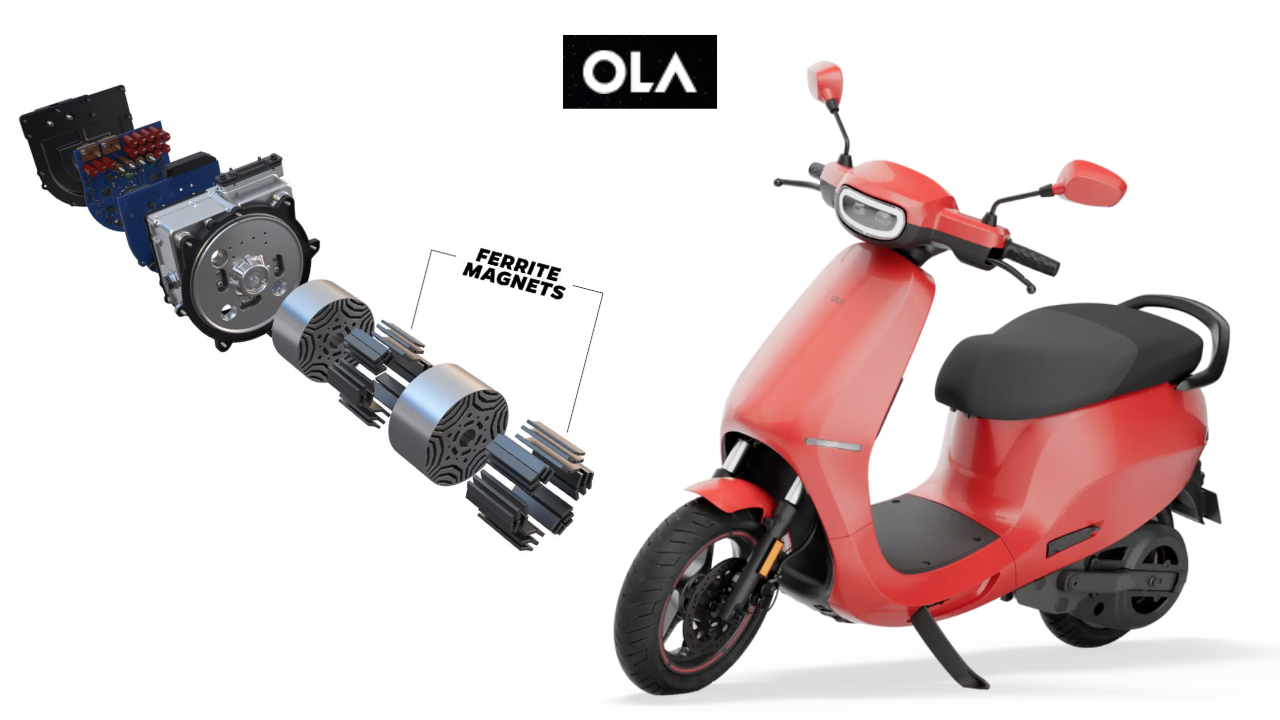
Ola Electric has secured government certification for its in-house developed ferrite motor, marking the first time an Indian OEM has received approval for a rare-earth-free motor. The motor matches performance of rare-earth permanent magnet motors and will be integrated into Ola’s vehicle lineup.

Keshav Rajput
Updated Oct 8, 2025, 05:19 PM IST
Ola Electric Becomes First Indian OEM to Get Approval for Ferrite Motor
Ola Electric announced that its ferrite motor had been certified by the Global Automotive Research Centre (GARC), Tamil Nadu, following performance tests under the AIS 041 standard prescribed by India’s Ministry of Road Transport.

People Also Search
What impact does Ola Electric's ferrite motor certification have on the Indian EV market's technological self-reliance?
How does the Roadster X series differentiate itself from Ola Electric's previous scooter models?
What are the expected benefits of Ola Electric's certification under the Production Linked Incentive (PLI) Scheme?
What advancements in battery technology are being pursued by Ola Electric?
What collaborative efforts are being made in India to develop rare earth-free motor technologies?
Performance Comparable to Rare-Earth Motors
The certification process included mandatory motor power and efficiency tests. According to the results, Ola’s 7 kW and 11 kW ferrite motor variants delivered net power comparable to their rare-earth permanent magnet counterparts.
Reducing Dependence on Rare-Earth Materials
By using a ferrite motor instead of one based on rare-earth permanent magnets, Ola aims to decrease its reliance on imported rare-earth materials, thereby mitigating supply-chain risks and stabilising cost inputs.
Integration Across Vehicle Lineup
With certification in hand, Ola plans to roll out the ferrite motor across its two-wheeler EV models. The firm says the design and performance are ready for commercial deployment.
Significance for India’s EV Sector
This development is notable because, while ferrite motor concepts are known globally, certifying an indigenous design that meets performance standards is a step toward greater technological self-reliance in India’s EV industry.
In a Social Media post, Ola Electric's Bhavish Aggarwal, said, "At Ola Electric, we’ve always believed that India’s EV revolution must be powered by technologies developed and manufactured in our own country. Earlier this year at our annual Sankalp 2025 event, we made a commitment to build and commercially produce a ferrite motor that eliminates the use of rare-earth materials. Today, we’ve delivered on that promise."
Recently, Ola Electric also received certification under the Production Linked Incentive (PLI) Scheme for the automobile and auto component sector. The certification, issued by the Automotive Research Association of India (ARAI) under the Ministry of Heavy Industries, applies to all seven scooters in the company’s S1 Gen 3 portfolio.
Log in to post a comment.
End of Article
Trending
2027 Harley-Davidson Sprint 440 Breaks Cover Ahead Of EICMA 2026 Debut; Will it Come to India?
Norton 450 Urban Roadster Revealed Ahead of EICMA 2026 Debut
Hero Xpulse 421 Teased Ahead of EICMA 2026 Debut; India Launch Expected in 2027
Hyundai Registers Over 16 Percent Growth in Car Sales for October 2026
Mahindra Posts Over 2 Percent Growth in Monthly Car Sales for October 2026
Maruti Suzuki Records Over 20 Percent Growth in Car Sales for October 2026
New Mini Cooper SE India Launch on November 27: Expected Price, Range, Battery, Features and More
Popular

STAY UPDATED Get the latest news from Times Drive