New Delhi


Ex-Showroom vs On-Road Price: What is The Difference and What Do You Actually Pay?
When purchasing a vehicle, understanding the distinction between the ex-showroom price and the on-road price is crucial. The ex-showroom price reflects the vehicle's base cost and applicable taxes, while the on-road price incorporates additional expenses.

Updated Oct 7, 2026, 07:30 PM IST
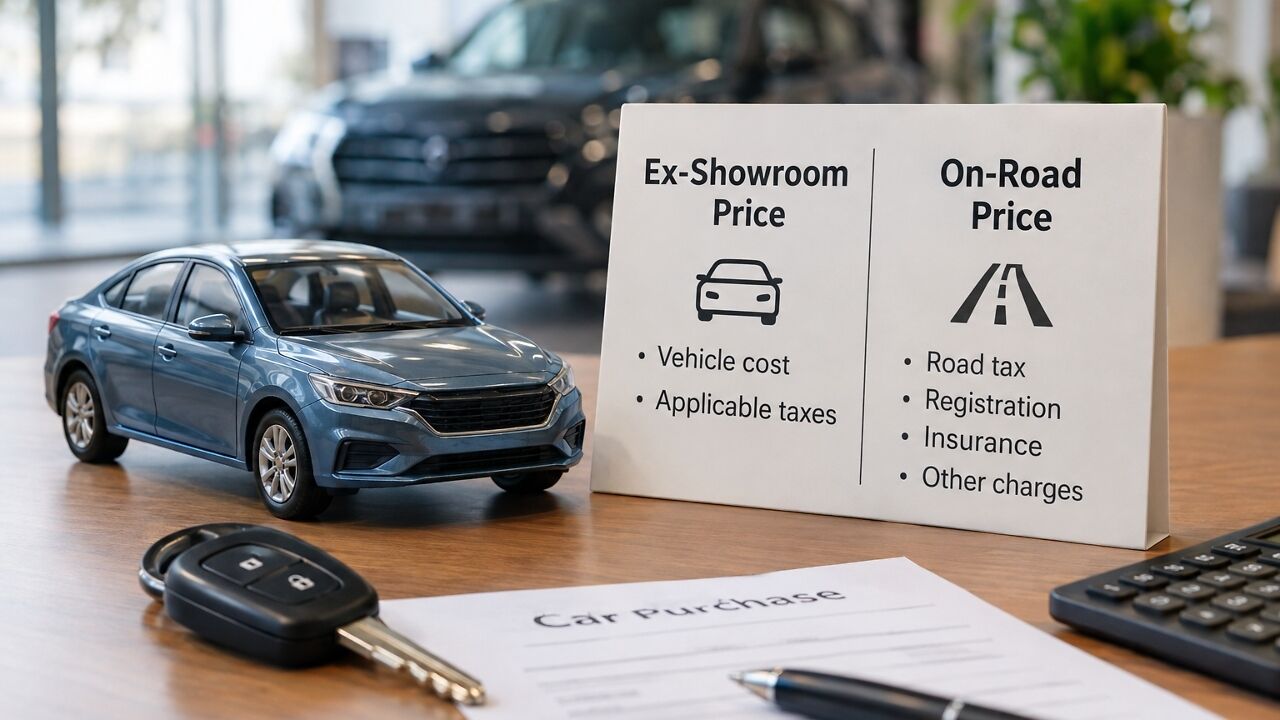
Ex-Showroom vs On-Road Price: What is The Difference and What Do You Actually Pay? (Image: AI-Generated)
May appear in some dealer quotations; buyers should verify their validityHandling/logistics chargesWhen buying a new car or bike, the price displayed in advertisements is usually not the final amount you pay at the dealership. The ex-showroom price covers the vehicle itself and certain applicable taxes, while the on-road price includes additional costs such as registration, road tax and insurance. Understanding the difference can help buyers plan their budget more accurately.
What is the difference between ex-showroom and on-road price?
Ex-showroom is the vehicle price before registration-related charges, while on-road adds road tax, registration, insurance and other applicable charges, and varies by state, fuel type and price band. In simple terms, the ex-showroom price is closer to the manufacturer's listed price, while the on-road price represents the amount a customer generally needs to pay to legally take the vehicle onto public roads.
| Price | What it generally includes |
| Ex-showroom price | Vehicle cost and applicable taxes |
| On-road price | Ex-showroom price + road tax + registration + insurance + other applicable charges |
What charges are added to the ex-showroom price?
Several charges can be added to the ex-showroom price before arriving at the final on-road figure. The exact amount depends on the vehicle, location and applicable government rules.
| Charge | What it means |
| Road tax | Tax charged by the state for using the vehicle on public roads |
| Registration fee | Fee for registering the vehicle with the Regional Transport Office (RTO) |
| Insurance | Mandatory motor insurance required to drive the vehicle legally |
| FASTag | Required for eligible vehicles and generally arranged during delivery |
| Hypothecation charges | May apply when the vehicle is purchased through a loan |
| Handling/logistics charges | May appear in some dealer quotations; buyers should verify their validity |
| Accessories | Optional items such as floor mats, mud flaps and seat covers |
| Extended warranty | Optional coverage beyond the standard warranty |
Why does the on-road price differ from state to state?
The biggest reason is that road tax and registration charges are determined by state-level rules. Different states can use different rates and calculation methods. Road tax may be linked to factors such as the vehicle's price, engine capacity, fuel type, vehicle category, age or other criteria. Some states also have different tax structures for electric vehicles.
For this reason, the same car can have different on-road prices in Delhi, Maharashtra, Karnataka, Tamil Nadu or other states, even when its ex-showroom price remains unchanged.
Does fuel type affect the on-road price?
Yes, fuel type can affect the final price in some cases. States may have different tax structures or incentives for petrol, diesel, CNG, hybrid and electric vehicles. Electric vehicles, for instance, may receive registration or road-tax benefits in some states, although such incentives can differ and may change over time. The vehicle's price band can also matter. Some states apply different road-tax rates depending on the value of the vehicle.
Can insurance make a significant difference to the on-road price?
Yes. Insurance is one of the major components of the on-road price. The premium can vary depending on the vehicle, insurer, coverage, location, add-ons and other factors. Customers should compare insurance quotations rather than automatically accepting the dealership's insurance package. However, buyers should ensure that the policy provides the legally required coverage and meets their needs.
Are dealer accessories included in the on-road price?
Not necessarily. Accessories such as floor mats, seat covers, alloy wheels, dash cameras and other add-ons are generally optional. A dealership may provide a quotation containing these items, but buyers can ask for a basic on-road quotation without optional accessories. This makes it easier to understand the actual cost of purchasing the vehicle.
How can you check the on-road price before booking?
The easiest way is to ask the dealer for a detailed, itemised quotation before paying a booking amount.
The quotation should clearly show:
- Ex-showroom price
- Road tax
- Registration charges
- Insurance premium
- FASTag or other applicable charges
- Hypothecation charges, if applicable
- Accessories, if selected
- Extended warranty, if selected
- Any other fees or charges
- Final on-road amount
Can the on-road price change after booking?
It can, depending on the circumstances. Government taxes, registration charges, insurance premiums or manufacturer prices may change between booking and delivery. Therefore, buyers should ask the dealership whether the quoted price is valid until delivery and whether any price increase or tax revision could affect the final invoice.
Why is it important to compare the two prices?
Looking only at the ex-showroom price can make two vehicles appear closer in price than they actually are. The on-road price gives a more realistic picture of the amount required to purchase and register the vehicle.
For buyers working with a fixed budget, comparing on-road prices is therefore more useful than comparing ex-showroom prices alone.
FAQs
Is ex-showroom price the final price of a car?
No. Ex-showroom price generally excludes costs such as road tax, registration and insurance. The final amount payable by the customer is usually higher.
What is included in the on-road price?
It generally includes the ex-showroom price, road tax, registration charges, insurance and other applicable charges. Optional items such as accessories and extended warranties may also be added.
Why is on-road price different in different states?
Road tax and registration-related charges are governed by state-level rules. As a result, the same vehicle can have different on-road prices in different states.
Is insurance included in the ex-showroom price?
Generally, no. Insurance is usually added separately when calculating the on-road price.
Can I negotiate the on-road price?
You can ask the dealer for discounts, insurance alternatives and removal of optional accessories. Government charges such as road tax and registration fees generally cannot be negotiated.
Which price should I consider when planning my car budget?
The on-road price is the better figure to consider because it provides a closer estimate of the amount you will actually need to pay for the vehicle.
Are accessories compulsory with a new car?
No, optional accessories are generally not compulsory. Ask for an itemised quotation and remove any accessories you do not want.
Can electric vehicles have lower on-road prices?
They can in states that provide EV-related road-tax or registration benefits. However, incentives vary by state and can change, so buyers should check the applicable rules at the time of purchase.
Log in to post a comment.
End of Article
Trending
Car Safety Features Explained: From Airbags to ADAS, What Do They Actually Do?
How To Drive An Automatic Car: A Beginner’s Guide

How To Choose The Right Tyres For Your SUV: HT vs AT vs MT Explained

Honda Elevate Facelift vs Hyundai Creta Spec Comparison: What's Different?

Skoda Slavia Facelift vs Volkswagen Virtus Spec Comparison: What's Different?

Electric Cars with BaaS You Can Buy in India: From MG Windsor to Tata Tiago

Skoda Slavia Facelift vs Honda City Spec Comparison: What's Different?
Popular

STAY UPDATED Get the latest news from Times Drive