New Delhi


ZF to Showcase Software-Based Chassis System for Tyre Noise Reduction at CES 2026
Tyre noise is a significant disruption in quieter vehicles, prompting ZF to introduce the Active Noise Reduction function at CES 2026. This software-based system minimizes vibrations from tyres transmitted through chassis components without needing extra insulation. The technology is designed for various vehicle segments and aligns with ZF's broader Chassis 2.0 strategy, with production expected to start in 2028.

Keshav Rajput
Updated Dec 18, 2025, 11:00 AM IST
ZF to Showcase Software-Based Chassis System for Tyre Noise Reduction at CES 2026
Tyre noise remains a key source of disturbance inside vehicle cabins, particularly as powertrains become quieter. ZF is scheduled to showcase a new software-based chassis function, called Active Noise Reduction, at the Consumer Electronics Show (CES) 2026, which will take place from January 6 to 9.

People Also Search
How does ZF's steer-by-wire technology differ from traditional steering systems?
What advancements are being made in electric motor production by ZF?
What is the purpose of Renault's Apache program in relation to noise pollution?
How does ZF's new electromechanical seatbelt locking system enhance safety in semi-autonomous vehicles?
What role does Bosch's new software play in vehicle safety related to tyre management?
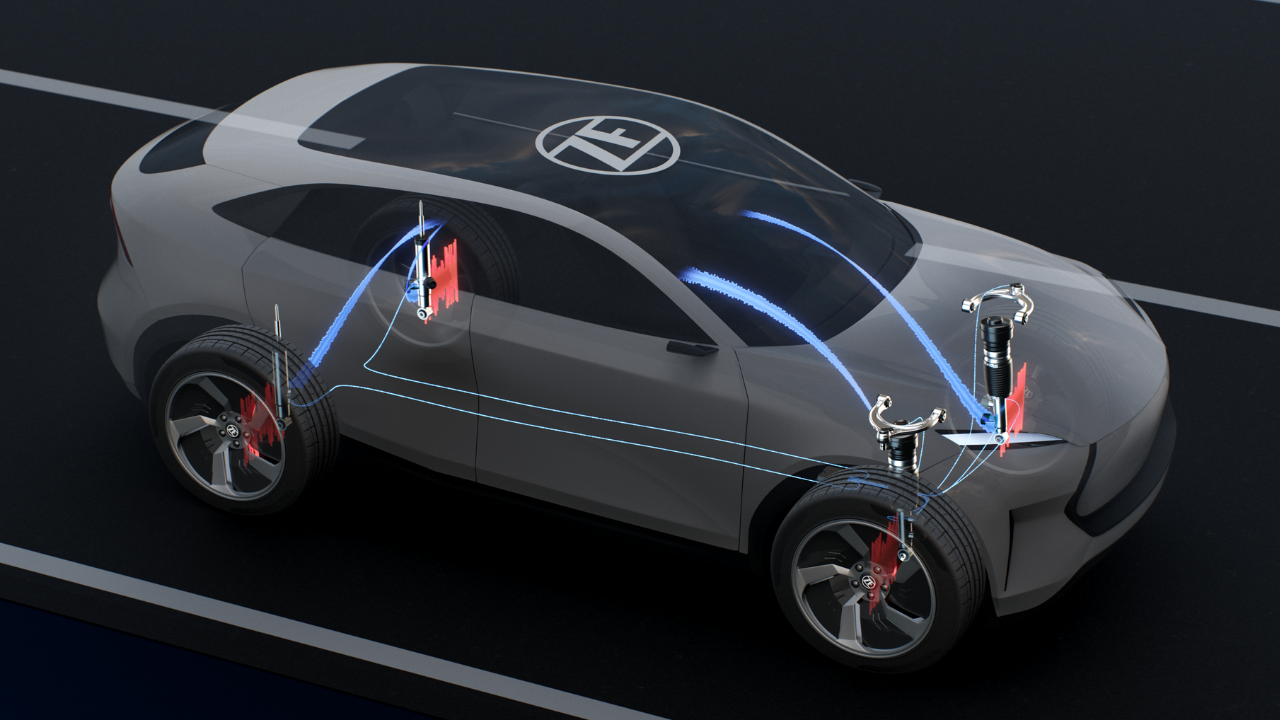
The function is designed to reduce vibrations that travel from the tyres into the vehicle structure through chassis components such as control arms and dampers. The system does not rely on additional insulation materials or acoustic hardware.
How the Technology Is Designed to Work
The Active Noise Reduction function will use ZF’s Smart Chassis Sensor, which includes an integrated acceleration sensor to measure vibrations transmitted from the tyres to the chassis. These signals are processed by a software algorithm that is designed to identify characteristic noise patterns, including tyre cavity noise, typically occurring around 200 Hz.
Based on this analysis, the software will generate counter-signals via ZF’s cubiX control software. These signals will be applied through the valves of semi-active CDC (Continuous Damping Control) dampers, enabling micro-adjustments that are intended to reduce noise transmission without affecting suspension performance.
Expected Noise Reduction Levels
ZF has stated that the current development stage of the software is expected to achieve in-cabin noise reductions of more than 3 decibels. Future iterations of the system are projected to reach reductions of up to 10 decibels.
Application Across Vehicle Segments
The company has indicated that the system is being developed to suit a wide range of vehicles, including lower-priced segments where advanced acoustic solutions are less common. By using existing semi-active dampers, the technology could be deployed without significant cost increases.
ZF supplies approximately 40 percent of semi-active dampers globally, which could support wider adoption of the software function as vehicles move toward software-defined architectures.
Also Read: Best Kawasaki Bikes In India under Rs 5 Lakh
Integration With Chassis 2.0 Strategy
Active Noise Reduction forms part of ZF’s Chassis 2.0 strategy, which focuses on enabling new vehicle functions through software and connected actuators. The approach integrates braking, steering, and damping systems within a scalable electronic architecture.
ZF has said that series production of the Active Noise Reduction software is planned to begin in 2028. The company is also evaluating the potential use of similar software-based noise control functions for other components, including braking systems and fully active suspension technologies.
Also Read



Log in to post a comment.
End of Article
Trending

BMW F 450 RR Revealed: Gets 48hp Engine, Sporty Design and Advanced Safety Features

Maruti Suzuki Brezza Facelift Crosses 1 Lakh Bookings in India

BS7 Emission Norms Proposed for April 2029: What Can Change for Cars in India?

Maruti Suzuki Brezza Crosses 15 Lakh Sales Milestone in India

BSA Gold Star 650 Gets Two New British Heritage-Inspired Colour Options in India

Ferrari Luce EV to Debut in India on October 17 with 1,050PS Power and 530 km Range

Mahindra XUV 3XO CNG Launched in India: Top 5 Highlights
Popular





STAY UPDATED Get the latest news from Times Drive