New Delhi


India's CAFE III Norms Embrace Green Credit Trading While US Scraps Program: The Global Policy Split Explained
The CAFE III norms in India will come into effect from April 1st 2027 and will remain applicable until March 31st 2032. The framework comes at a time when the US is moving in the opposite direction, with its revised CAFE rules set to discontinue inter-manufacturer credit trading from 2028.

Updated Oct 1, 2026, 11:58 AM IST
India's CAFE III Norms Embrace Green Credit Trading While US Scraps Program: The Global Policy Split Explained (AI generated image for representation only)
India is set to introduce a compliance credit trading mechanism under the new Corporate Average Fuel Economy (CAFE) III norms. The CAFE III norms will come into effect from April 1st 2027 and will be valid till March 31st 2032. The new framework will progressively tighten fuel-efficiency requirements for passenger vehicle manufacturers and provide additional compliance benefits for electric vehicles, hybrids and alternative-fuel vehicles.
Under the new norms car manufacturers can use credits to meet fleet-level efficiency requirements. The system will allow manufacturers that outperform their targets to generate credits, while those falling short can use or purchase credits to meet their obligations.
This development comes as the US moves in the opposite direction. The revised US CAFE framework is set to end inter-manufacturer credit trading from 2028.
CAFE III Credit Trading Explained
Under the new Indian framework, carmakers will receive credits when their fleet performs better than the prescribed fuel-efficiency and CO2 targets. Manufacturers falling short of their targets can use available credits to meet their compliance requirements.
The government will maintain manufacturer-level credits and debits through a compliance passbook. The CAFE III framework divides the compliance period into two blocks - FY2027-28 to FY2029-30 and FY2030-31 to FY2031-32. Credits remaining unsettled at the end of the respective compliance period will lapse. Manufacturers with a deficit can also purchase credits from the Bureau of Energy Efficiency. The notified price starts at Rs 2,500 per g CO2/km in FY2027-28 and rises to Rs 4,500 per g CO2/km by FY2031-32.
US Moves to End Inter-Manufacturer Credit Trading
The Indian approach comes as the US prepares to remove inter-manufacturer CAFE credit trading. Under the revised US CAFE framework, inter-manufacturer credit trading is scheduled to end from model year 2028. The revised standards also reduce the fleetwide fuel-economy targets compared with the earlier rules. The US Department of Transportation has said the changes will reduce compliance costs for manufacturers.
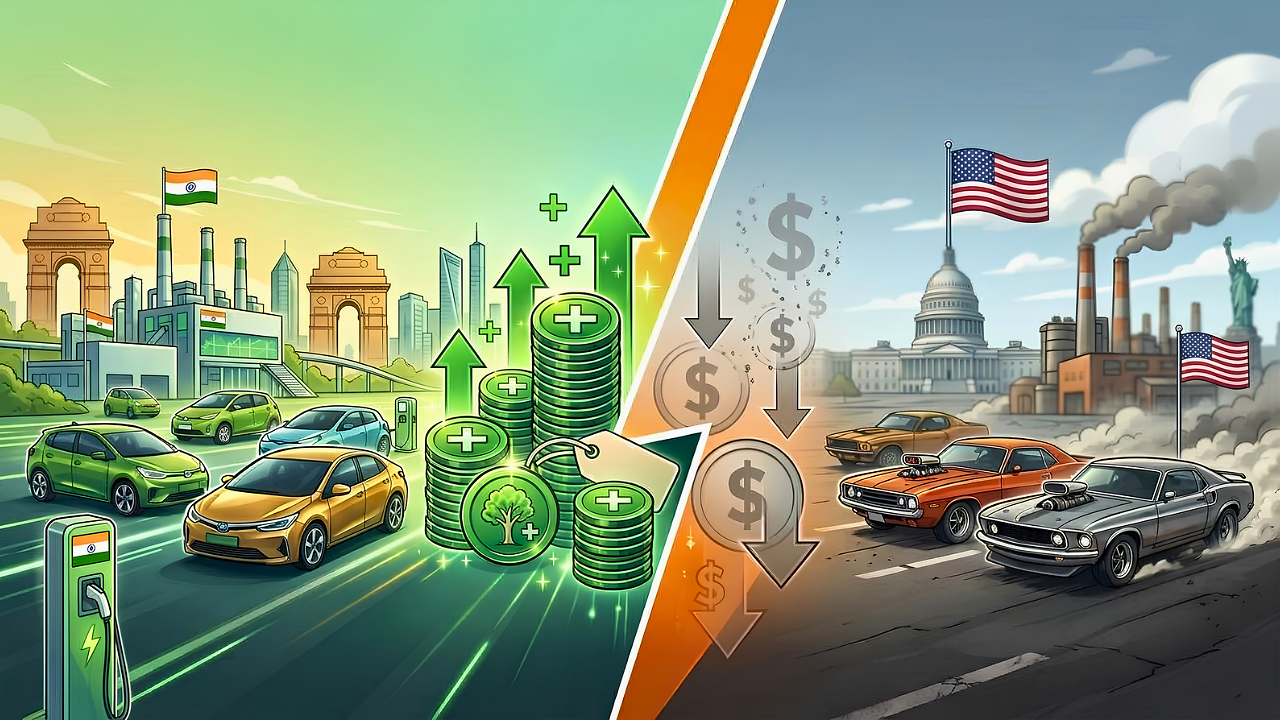
This creates a clear difference between the two regulatory approaches. India is introducing a credit-trading mechanism as it tightens fleet-average efficiency requirements, while the US is moving towards ending inter-manufacturer trading.
What CAFE III Norms Mean for Car Manufacturers
The upcoming CAFE III norms are likely to influence the powertrain strategy of car manufacturers in India from 2027. Automakers will have to balance their vehicle portfolios across petrol, CNG, hybrid, flex-fuel and electric powertrains while meeting their fleet-level efficiency targets.
CAFE III Norms Get Stricter
CAFE III will progressively reduce the permissible fleet-average fuel consumption for passenger vehicle manufacturers. For a reference fleet weight of 1,229 kg, the fuel-efficiency benchmark will move from 3.996 litres/100 km in FY2027-28 to 3.3273 litres/100 km in FY2031-32. The reference weight has also been increased from 1,082 kg under the existing CAFE framework to 1,229 kg under CAFE III. The regulations take vehicle weight into account while calculating manufacturer-specific targets.
EVs Get Highest Super Credit
Electric vehicles will receive the highest super-credit benefit under CAFE III. Battery electric vehicles and range-extended electric vehicles will receive a 3X multiplier. Plug-in hybrids and flex-fuel strong hybrids will receive a 2.5X multiplier, while strong hybrids will get a 1.6X multiplier. Flex-fuel vehicles will receive a 1.1X multiplier. The mechanism is designed to give manufacturers greater compliance benefits for selling vehicles with lower carbon emissions.
Alternative Fuels Also Included
CAFE III also recognises alternative fuel technologies instead of focusing only on electric vehicles. The framework introduces a Carbon Neutrality Factor for fuels such as ethanol-blended petrol, biofuels and compressed biogas. Vehicles running on E20 or higher ethanol-petrol blends receive an 8 percent carbon-neutrality factor for tailpipe CO2 calculations. Flex-fuel ethanol vehicles receive a 22.3 percent factor. CNG vehicles receive a 5 percent factor or the notified CBG blending percentage, whichever is higher.
Also Read



Log in to post a comment.
End of Article
Trending

BMW F 450 R to Launch in India Today: What to Expect?

Hyundai Records Over 10 Percent Growth in Car Sales for September 2026

Aston Martin DBX GT Debuts with 717Bhp V8 Blending Opulence with Track Power

Royal Enfield Himalayan 440 Bookings Paused in India as Waiting Period Reaches 6 Months

Older Porsche Models Get New Infotainment Upgrade: Apple CarPlay and Android Auto Added

CAFE III Norms 2027: Govt Tightens Fuel Efficiency Rules For Cars, EVs Get Super Credits

Nissan Gravite, Magnite Prices to Increase From October 1: Here’s What We Know
Popular





STAY UPDATED Get the latest news from Times Drive